
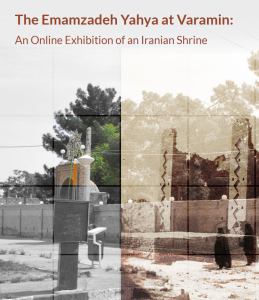
 Review of The Emamzadeh Yahya at Varamin: An Online Exhibition of an Iranian Shrine, directed by Keelan Overton.
While traditional formats such as books and journal articles remain dominant modes of academic publishing, the dissemination and exchange of knowledge have long outgrown these mediums. The inherent limitations of print—including content compression, imposed linearity, and the exclusion of research processes—have become increasingly apparent. These constraints are further compounded by disciplinary boundaries and institutional biases that hinder the integration of diverse perspectives and interdisciplinary dialogue, particularly in the humanities and fields such as art and architectural studies. In this context, exploring alternative scholarly forms is not merely desirable but necessary. The expansion of the web and digital technologies has not only broadened access to sources but also introduced new tools and methods of research, enabling more flexible and multimodal forms of presentation.
An exemplary effort to leverage contemporary digital tools in response to these constraints is the Emamzadeh Yahya at Varamin: An Online Exhibition of an Iranian Shrine. In this project, Keelan Overton and her collaborators present recent research on the shrine of Emamzadeh Yahya through a dedicated website, aiming to construct a comprehensive portrait of the monument. The mausoleum of Yahya ibn Ali, a descendant of Imam Hasan, is an Ilkhanid pilgrimage site whose distinctive architectural features—particularly its luster tiles—have attracted scholarly attention for over a century. Yet existing studies have often focused on isolated periods or aspects, and the monument remains marginal in canonical accounts of Iranian architectural history. This independent project repositions the Emamzadeh as a central subject through which multiple research trajectories unfold, illuminating its often-overlooked dimensions.
The virtual exhibition opens with six main galleries, immediately presenting the subject at multiple scales and across distinct domains. The Varamin, Building, and Luster galleries focus on the shrine’s urban setting, architectural structure, and decorative elements. The Ritual, People, and Museum galleries move beyond material form to explore beliefs and practices, individuals associated with the site—such as the entombed, pilgrims, and restorers—and the afterlives of its artifacts, traced through collections and archives.
Each gallery is divided into six thematic sections that address a fluid range of historical, artistic, religious, anthropological, and social concerns—such as Architectural Heritage, Interiors, Twelver Shiʿism, and Pilgrims. These sections move across the tomb’s physical structure and its broader historical and contemporary contexts, approaching them from multiple angles—as reflected in titles like Stucco Inscription, Travels of a Mihrab, City Tour, and Site Tour.
In addition to the galleries, the exhibition’s Checklist offers supplementary information through entries on shrines and related cultural traditions and spaces. These entries are organized under themes such as The Tomb, Architectural Features, Sacred Atmosphere, Personal Piety, and Collective Practices. Alongside academic articles and thematic essays, the website includes a wide array of media formats—historical and contemporary images, videos, audio-visual reports, interviews, interactive and historical maps, and 3D reconstructions.
The website lacks a search function—by design, as a hand-coded PHP project without a backend database—but instead offers a detailed Table of Contents that conveys the hierarchy and interrelations among topics, mitigating this limitation. A coherent thematic organization, combined with a clean aesthetic, enhances the site’s readability and ease of access. Extensive internal and external hyperlinks create a dynamic web of connections, allowing users to explore content across sections and access key resources beyond the site. This flexible structure enables each visitor to engage with the material at a depth and scale suited to their interests. Tools like the historical Timeline and the Photo Timeline further contextualize events chronologically, making thematic connections more tangible and enriching historical understanding.
The project’s broad and multilayered collaboration extends beyond interdisciplinarity or the involvement of over forty Iranian and international scholars. It actively incorporates local knowledge through interviews with community members, collaborations with regional artisans, and engagement with vernacular sources—as seen in sections like Community, Oral History, and History of Luster. These efforts, alongside references to regional and international collections—such as Luster Tiles, Doha and the Louvre Photo Archive—contribute to a more nuanced and polyvocal narrative. Persian-speaking users benefit from the website’s multilingual presentation— with a significant portion of the English and French content translated into Persian, and all Persian-language contributions translated into English—which, combined with its digital format, grants them unmediated access to the full scope of the research. The project’s attention to linguistic and cultural context is reflected in the accuracy and clarity of its Persian translations, as well as in considered details such as the use of a customized Persian typeface.
More than a platform for publishing research on Emamzadeh Yahya, the website serves as a rich scholarly resource, offering original studies alongside bibliographies and external links to related literature and prior research. Its digital format accommodates research processes, decisions, and experiences often excluded from final publications. From an educational standpoint, it functions as a valuable tool for both instructors and students. For educators, its multimedia features, diverse perspectives, and concise, self-contained studies provide a versatile teaching resource and a model for course project design. For students, its interactive and visual components offer a learning experience distinct from conventional materials, fostering multidimensional engagement and encouraging research and collaboration.
The Emamzadeh Yahya at Varamin exemplifies how digital platforms can expand access to heritage otherwise difficult to reach. By mitigating linguistic, geographic, and institutional barriers, the project opens new avenues for broader engagement. Like many digital initiatives—and especially as an independent project—it must also contend with challenges specific to the medium. Long-term sustainability concerns place it within the broader precarity of the field, including limited funding, individual stewardship, domain retention, data security, and infrastructure maintenance. In this case, a deliberately low-maintenance and low-risk design and mid-term hosting on the Khamseen platform provide partial stability—highlighting how such projects navigate structural constraints through practical and contractual means. Moreover, while the exhibition is conceived as a fixed scholarly product with no plan for ongoing updates, the few remaining sections still in progress reflect a familiar feature of digital scholarship: the phased release of content and the fluid, potentially revisable boundaries of scholarly work in online environments. Despite the complexities of digital scholarship, the project offers a compelling model for reframing heritage as a living, contextual, and publicly engaged field of inquiry—prompting us to rethink what counts as research, and whom it is for.
Haleh Yasini
Research Associate, Nowruzgan Laboratory for Study of the Persianate World